Municipal water treatment facilities face a growing number of challenges as aging infrastructure, changing water quality conditions, population growth, and increasingly stringent drinking water regulations place additional demands on existing filtration systems. Equipment that adequately served a community twenty years ago may no longer provide the capacity, efficiency, or contaminant removal capabilities necessary to meet today’s requirements.
Upgrading a municipal water filtration system involves much more than replacing aging equipment. Municipalities must evaluate current and anticipated water quality concerns, treatment capacity, operating expenses, regulatory compliance, infrastructure compatibility, and long-term sustainability. Every decision can influence the reliability and affordability of water treatment for decades.
At Yardney Water Filtration Systems, we specialize in advanced water filtration technologies engineered for demanding applications. From conventional sand media filtration to specialized treatment solutions for PFAS, arsenic, iron, manganese, and other contaminants, we help municipalities identify filtration technologies suited to their specific water quality challenges and operational objectives.
Evaluating the Performance of Existing Water Filtration Infrastructure
Before selecting new filtration equipment, municipalities should conduct a comprehensive assessment of their existing treatment infrastructure. Understanding where current systems are underperforming helps establish priorities and prevents unnecessary investments in equipment that may not address the underlying problem.
Indicators that a municipal water filtration system may require upgrading include:
- Increasing differential pressure across filtration equipment
- More frequent backwashing requirements
- Declining filtration efficiency
- Inconsistent treated water quality
- Rising energy and water consumption
- Increasing equipment maintenance and repair costs
- Insufficient treatment capacity during peak demand
- Difficulty addressing newly identified contaminants
- Limited availability of replacement components
Municipalities should examine historical water quality data alongside equipment performance records. A filtration system experiencing operational difficulties may be responding to changes in source water characteristics rather than equipment deterioration alone.
At Yardney Water Filtration Systems, we recognize that effective filtration upgrades begin with understanding the relationship between source water quality, existing treatment processes, and desired treatment outcomes. This application-specific approach helps municipalities invest in equipment that addresses actual operational needs.
Understanding Current and Emerging Water Quality Concerns
Municipalities must consider both established contaminants and emerging water quality concerns when planning filtration upgrades. Designing a system exclusively around today’s treatment requirements could leave a community facing another significant infrastructure investment in the future.
Depending on geographical location, groundwater characteristics, industrial activity, and surrounding land use, municipal water supplies may contain:
- Per- and polyfluoroalkyl substances (PFAS)
- Iron and manganese
- Arsenic
- Hexavalent chromium (chromium 6)
- 1,2,3-Trichloropropane (1,2,3-TCP)
- Microplastics
- Suspended solids and sediment
- Naturally occurring organic matter
- Other industrial and agricultural contaminants
Each contaminant presents different treatment challenges. Dissolved arsenic, for example, requires a substantially different treatment approach than suspended sediment. Similarly, PFAS remediation may require granular activated carbon or specialized ion exchange resin rather than conventional sand media filtration.
The U.S. Environmental Protection Agency’s drinking water treatability database provides information about contaminant characteristics and the effectiveness of various treatment technologies under different conditions.
Yardney Water Filtration Systems offers multiple filtration technologies and specialized media options, allowing municipalities to develop treatment strategies based on their particular contaminant profiles rather than relying on a one-size-fits-all solution.
Selecting the Right Municipal Water Filtration Technology
One of the most consequential decisions during a municipal filtration upgrade is selecting the appropriate filtration technology. Different filtration methods serve different purposes, and many facilities benefit from incorporating multiple technologies into their treatment processes.
Sand Media and Multi-Media Filtration
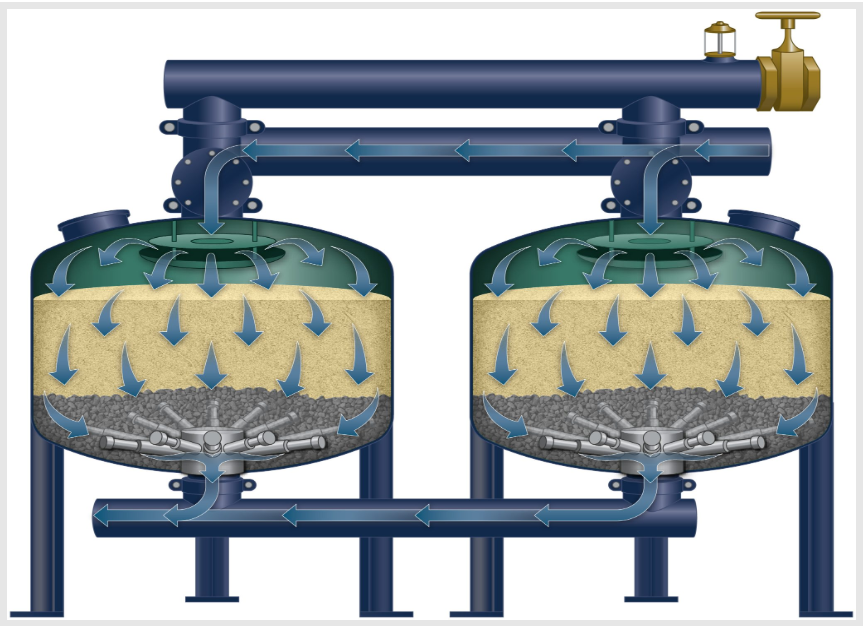
Sand media filters provide effective removal of suspended solids, sediment, and particulate matter. Multi-media filters incorporate different filtration media, potentially including silica sand and garnet, to capture particles throughout the filter bed and improve solids-holding capacity.
These technologies can also provide valuable pretreatment, reducing particulate loading on downstream contaminant removal equipment and membrane systems.
Granular Activated Carbon Filtration
Granular activated carbon (GAC) filters utilize adsorption to remove certain dissolved contaminants, organic compounds, and substances affecting water taste and odor. GAC is also an established treatment technology for certain PFAS compounds and 1,2,3-TCP.
Carbon selection, contact time, competing contaminants, and anticipated media replacement requirements should all factor into system design.
Ion Exchange Filtration
Ion exchange (IX) filtration uses specialized resins to capture targeted dissolved contaminants. Depending on resin selection and water chemistry, ion exchange can be an effective treatment option for certain PFAS compounds and other contaminants.
Specialized Contaminant Removal Media
Municipalities addressing iron, manganese, or arsenic may require specialized filtration media and appropriate pretreatment processes. Media selection must account for contaminant concentrations, chemical form, pH, oxidation requirements, and other water chemistry considerations.
Yardney Water Filtration Systems provides a diverse range of filtration equipment and media selections, helping municipalities match treatment technologies to specific water quality objectives.
Planning for Regulatory Compliance and Future Treatment Requirements
Municipal drinking water regulations continue to evolve as research improves understanding of contaminants and their potential health effects. Filtration infrastructure designed around historical requirements may not adequately address future drinking water standards.
The EPA’s National Primary Drinking Water Regulations establish enforceable federal drinking water standards for regulated contaminants. Municipalities must also consider state-specific requirements, which may establish additional or more stringent contaminant limits.
Rather than designing filtration upgrades solely around minimum compliance requirements, municipalities should evaluate opportunities to incorporate additional treatment flexibility. Expandable filtration configurations, interchangeable media options where technically appropriate, and provisions for future treatment stages can help facilities adapt as requirements change.
At Yardney Water Filtration Systems, our application-specific approach supports municipalities seeking dependable filtration performance while accounting for evolving treatment needs and long-term infrastructure investments.
Assessing Treatment Capacity, Flow Rates, and Future Demand
Population growth, residential development, commercial expansion, and seasonal water consumption can significantly affect municipal water demand. Filtration equipment must accommodate these fluctuations without compromising treatment effectiveness.
Municipalities should evaluate average daily flow rates, peak demand, anticipated population growth, source water availability, and treatment capacity during equipment maintenance. Filtration systems must also be appropriately sized to maintain the contact time necessary for effective contaminant removal.
Undersized equipment can experience excessive hydraulic loading, increased pressure loss, premature contaminant breakthrough, and accelerated media exhaustion. Oversized equipment, meanwhile, may introduce unnecessary capital expenses and inefficient operating conditions.
Yardney Water Filtration Systems helps municipalities evaluate filtration configurations that balance hydraulic performance, contaminant removal requirements, available installation space, and anticipated demand. Proper system sizing is essential to achieving dependable long-term performance.
Considering Existing Infrastructure and Installation Requirements
Municipal water treatment facilities cannot simply suspend operations for extended periods while filtration equipment is replaced. Maintaining a dependable water supply throughout an infrastructure upgrade requires careful planning and coordination.
Municipalities should evaluate how new filtration equipment will integrate with existing pumps, piping, valves, instrumentation, control systems, and treatment processes. Available installation space, equipment access, hydraulic limitations, and backwash water handling capabilities must also be considered.
Phased installations and parallel filtration configurations may allow facilities to maintain treatment capacity while individual components are upgraded or serviced. Municipalities should also consider whether existing infrastructure can be retained without limiting the performance of new equipment.
The introduction of Free Flow filtration solutions further expands the technologies available through Yardney Water Filtration Systems for municipal applications. Evaluating these solutions alongside established filtration technologies allows municipalities to explore configurations appropriate for their specific treatment objectives and infrastructure requirements.
Looking Beyond Initial Equipment Costs
Although capital expenditure is an important consideration, the purchase price of a municipal water filter represents only one portion of its total lifecycle cost. Equipment that appears economical initially may become considerably more expensive if it requires excessive maintenance, energy consumption, or frequent media replacement.
A comprehensive water filtration lifecycle cost analysis should account for:
- Equipment acquisition and installation
- Pumping and energy requirements
- Backwash water consumption
- Filtration media replacement
- Treatment chemical consumption
- Routine maintenance and replacement components
- Spent media and residuals disposal
- Operator labor and equipment downtime
The EPA’s asset management guidance for water and wastewater utilities emphasizes managing infrastructure investments to maintain service levels while controlling lifecycle costs.
At Yardney Water Filtration Systems, reliability and operational performance are fundamental design considerations. Selecting equipment appropriate for actual operating conditions can help municipalities reduce avoidable expenses and improve the long-term value of their filtration investments.
Prioritizing Water Conservation and Operational Sustainability
Municipal water treatment facilities must balance effective contaminant removal with responsible resource consumption. Filtration equipment that requires excessive backwashing, creates unnecessary pressure losses, or consumes large quantities of replacement media can undermine broader sustainability objectives.
Municipalities should evaluate backwashing efficiency, water recovery opportunities, pumping requirements, media service life, and treatment residuals management. Where appropriate, backwash water recovery may help reduce overall water consumption, provided recycling does not reintroduce problematic contaminants into the treatment process.
Effective pretreatment can also support sustainability by protecting downstream filtration equipment, extending media service life, and reducing unnecessary maintenance. These considerations are particularly important for municipalities investing in water reuse and advanced water treatment systems.
Yardney Water Filtration Systems understands the importance of balancing water quality objectives with responsible resource management. Our filtration technologies are engineered with reliability, performance, and application-specific operating requirements in mind.
Frequently Asked Questions About Municipal Water Filtration System Upgrades
Municipal decision-makers frequently encounter questions that extend beyond equipment selection. Addressing these considerations early can help facilities develop more comprehensive infrastructure improvement plans.
Should municipalities conduct pilot testing before purchasing filtration equipment?
Pilot testing can be particularly valuable when addressing complex contaminants or unfamiliar source water conditions. Testing allows municipalities to evaluate media performance, contaminant breakthrough, hydraulic characteristics, and treatment effectiveness using representative source water. Results can help establish realistic design parameters and reduce uncertainty before full-scale implementation.
What happens to filtration media after it captures contaminants?
Spent filtration media must be evaluated and managed according to applicable waste handling and disposal requirements. Depending on the media and contaminants involved, options may include replacement, regeneration, reactivation, or approved disposal. Municipalities treating PFAS and other persistent contaminants should pay particular attention to residuals management when developing project specifications and operating budgets.
Can seasonal changes affect the performance of newly installed filtration equipment?
Yes. Seasonal rainfall, drought, groundwater fluctuations, temperature changes, and agricultural runoff can alter source water characteristics. Municipalities should collect representative water quality data across different seasons to ensure equipment is designed for variable operating conditions rather than a single water sample.
What should municipalities include in filtration equipment procurement specifications?
Procurement specifications should establish measurable treatment objectives, design flow rates, operating pressure requirements, materials of construction, instrumentation needs, maintenance accessibility, and applicable drinking water contact material certifications. Clearly defined performance expectations and acceptance testing requirements can help municipalities evaluate proposals consistently and verify equipment suitability.
Why Partner with Yardney Water Filtration Systems
Upgrading municipal water filtration infrastructure is a significant investment that requires specialized technical expertise and a thorough understanding of water treatment challenges. At Yardney Water Filtration Systems, we provide advanced filtration solutions engineered to meet varied and demanding water quality requirements.
Our comprehensive product line includes backwashing sand media filters, multi-media filters, granular activated carbon filters, and specialized media selections for iron, manganese, arsenic, and other treatment applications. Our expanding municipal filtration offerings help communities address both established water quality concerns and emerging contaminants.
With filtration technology tested in hundreds of applications, thousands of times over, we bring proven design principles and extensive application expertise to municipal, industrial, commercial, agricultural, golf, turf, and landscape water filtration projects. We understand that every water source presents unique challenges and that effective filtration begins with selecting equipment suited to the application.
Whether your municipality is replacing aging filtration equipment, expanding treatment capacity, addressing PFAS and emerging contaminants, or preparing for future water quality requirements, Yardney Water Filtration Systems can help you identify a dependable, performance-driven solution. Contact us today at 951.656.6716 or email [email protected] to discuss your municipal water filtration needs.