Providing safe drinking water requires municipal water utilities to manage contaminants that are not always visible, detectable by taste, or easily removed through conventional treatment. Arsenic is one such contaminant. Naturally occurring in many groundwater sources, arsenic presents significant challenges for communities that rely on wells and other underground water supplies.
For municipal water treatment facilities, arsenic removal in drinking water involves more than installing a filtration system. Effective treatment requires understanding the source of contamination, identifying the chemical form of arsenic present, and selecting treatment technologies capable of consistently meeting regulatory requirements.
At Yardney Water Filtration Systems, we understand the importance of dependable water treatment infrastructure. Our advanced filtration technologies help municipal, industrial, and commercial customers address demanding water quality challenges. Through specialized filter media, engineered filtration systems, and application-specific treatment solutions, we help utilities develop reliable approaches to protecting drinking water quality.
Understanding Arsenic Contamination in Drinking Water
Arsenic is a naturally occurring element found in rocks, soil, and groundwater. As water moves through underground geological formations, arsenic can dissolve into the water supply. Its concentration varies considerably depending on local geology, groundwater chemistry, and environmental conditions.
Unlike contaminants that produce noticeable changes in water appearance or odor, arsenic generally cannot be detected without laboratory testing. A municipal groundwater source may appear completely clear while containing arsenic concentrations that exceed drinking water standards.
The U.S. Environmental Protection Agency (EPA) establishes a federal maximum contaminant level (MCL) for arsenic of 10 micrograms per liter (µg/L), equivalent to 10 parts per billion (ppb). Public water systems must comply with applicable monitoring and treatment requirements to maintain safe drinking water.
Long-term exposure to elevated arsenic concentrations has been associated with increased risks of certain cancers, cardiovascular problems, and other health effects. For municipal utilities, effective arsenic treatment is therefore an essential public health responsibility.
Why Arsenic Is Difficult to Remove From Municipal Water Supplies
One of the greatest challenges in municipal arsenic removal is that arsenic can exist in different chemical forms. The two most important forms in drinking water treatment are arsenite, commonly called arsenic III, and arsenate, known as arsenic V.
Arsenic III is generally more difficult to remove using common adsorption and filtration methods. Arsenic V, by comparison, is typically easier to capture using iron-based treatment processes and certain specialized adsorption media.
Water chemistry also influences treatment performance. Factors such as pH, competing dissolved substances, iron concentrations, and oxidation conditions affect how arsenic behaves during treatment.
For example, phosphate and silicate can compete with arsenic for adsorption sites, reducing the effectiveness or operating life of certain treatment media. These conditions make it important to evaluate the complete water quality profile rather than focusing exclusively on arsenic concentration.
At Yardney Water Filtration Systems, we recognize that effective arsenic filtration depends on selecting appropriate treatment components for actual operating conditions. A system designed around the characteristics of the source water is better positioned to provide consistent performance over time.
The Role of Oxidation in Arsenic Treatment
Oxidation is an important consideration when treating groundwater containing arsenic III. Because arsenic III is often less readily removed by adsorption processes, converting it into arsenic V can significantly improve treatment effectiveness.
Municipal water treatment facilities may use chemical oxidants such as chlorine or potassium permanganate to accomplish this conversion. The appropriate oxidant depends on water chemistry, existing treatment infrastructure, and operational requirements.
Oxidation alone does not remove dissolved arsenic from drinking water. Instead, it changes arsenic into a form that can be more effectively captured by subsequent treatment processes.
Proper sequencing is essential. When oxidation is incorporated into a treatment strategy, downstream filtration or adsorption equipment must be designed to handle the resulting water characteristics and any particles produced during treatment.
This is where engineered municipal water filtration systems become especially valuable. By supporting the removal of suspended solids and treatment-generated particles, appropriately selected filtration equipment can help maintain dependable operation throughout the treatment process.
Arsenic Removal Through Adsorption and Specialized Filter Media
Adsorption is one of the most widely used approaches for removing dissolved arsenic from drinking water. During this process, arsenic attaches to the surface of specialized treatment media as water passes through a treatment vessel.
Iron-based adsorption media are commonly used because arsenic has a strong affinity for certain iron oxide and iron hydroxide surfaces. Other specialized materials may also be appropriate depending on the source water and treatment objectives.
The effectiveness of an adsorption system depends on several factors, including media composition, contact time, flow rate, pH, and competing contaminants. Media eventually reaches its practical treatment capacity and must be replaced or regenerated where the technology permits.
Yardney Water Filtration Systems offers a range of filtration technologies and specialized media selections for demanding water treatment applications, including arsenic-related applications. Our approach emphasizes matching the filtration technology to the specific water quality challenge rather than assuming one media configuration will work in every installation.
Importantly, conventional sand media or multi-media filtration alone is not a dependable method for removing dissolved arsenic. These systems are primarily designed to capture suspended particles. Dissolved arsenic removal requires an appropriate treatment mechanism, such as specialized adsorption media or chemical treatment followed by particle separation.
How Iron and Manganese Affect Arsenic Removal
Iron and manganese frequently occur alongside arsenic in groundwater. Their presence can influence treatment design, filtration requirements, and long-term system performance.
When dissolved iron is oxidized, it can form iron hydroxide particles. Under suitable conditions, arsenic V can attach to these particles through adsorption or coprecipitation. The resulting solids can then be separated from the water using an appropriately designed filtration process.
This creates opportunities for municipal utilities to address multiple groundwater contaminants through coordinated treatment. However, the effectiveness of iron-assisted arsenic removal depends on the iron-to-arsenic relationship, oxidation conditions, pH, and other water quality factors.
Manganese requires additional consideration because its oxidation behavior differs from iron. Treatment systems designed for simultaneous iron, manganese, and arsenic removal must account for these differences to avoid inconsistent performance.
Yardney Water Filtration Systems provides filtration technologies and media options suitable for specialized iron and manganese treatment applications. We help customers evaluate how these filtration capabilities can support broader groundwater treatment strategies, including applications where arsenic removal is required.
How Backwashing Media Filters Support Arsenic Treatment
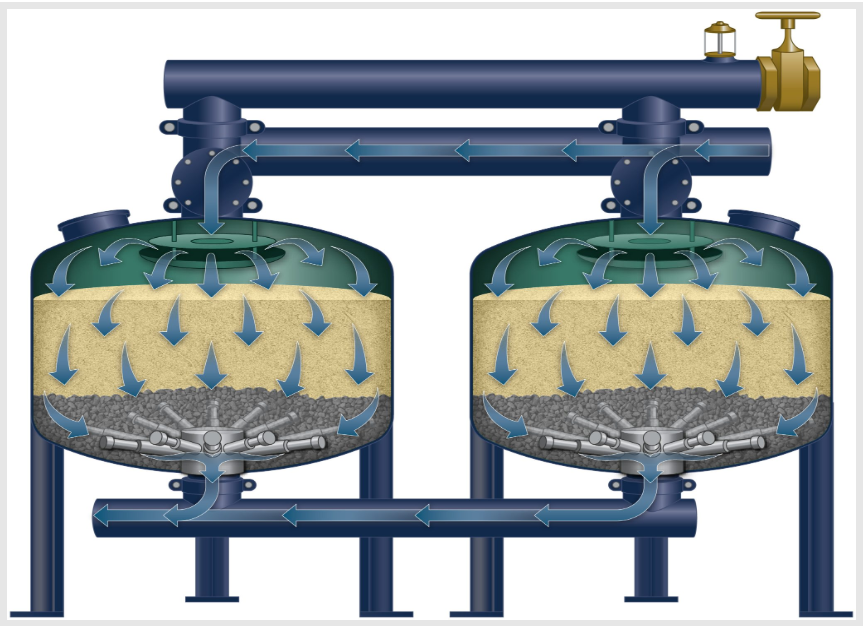
Backwashing media filters play an important role in municipal treatment systems where arsenic becomes associated with suspended particles. Following oxidation, coagulation, or iron precipitation, filtration removes the resulting solids before treated water enters distribution or additional treatment stages.
As particles accumulate, filtration resistance increases and operating efficiency may decline. Backwashing reverses water flow through the filter bed to release captured material and restore hydraulic performance. Properly designed backwashing cycles help maintain consistent filtration capacity.
Yardney Water Filtration Systems manufactures backwashing filtration systems incorporating Sand Media, Multi-Media, and Granular Activated Carbon technologies. We also offer specialized media selections for applications involving arsenic, iron, manganese, and other water quality challenges.
For arsenic applications, the selected media and upstream treatment processes determine whether dissolved arsenic is captured. Backwashing removes accumulated solids but does not restore exhausted arsenic adsorption capacity. Understanding this distinction helps utilities establish realistic maintenance schedules and treatment expectations.
Comparing Other Municipal Arsenic Removal Technologies
Although specialized media filtration is important, municipal utilities may also consider other established arsenic treatment technologies. The appropriate choice depends on water quality, treatment capacity, operating costs, and available infrastructure.
Coagulation and filtration involve adding chemicals, often iron-based coagulants, that promote arsenic attachment to newly formed particles. Filtration subsequently removes these particles. This approach can be particularly useful when utilities must treat larger water volumes or address several contaminants simultaneously.
Ion exchange uses specialized resins to capture dissolved arsenic V. However, competing ions can reduce treatment capacity, and resin regeneration may generate concentrated waste streams requiring appropriate management.
Reverse osmosis provides another treatment option by separating dissolved contaminants through a semipermeable membrane. Although effective under suitable conditions, reverse osmosis requires careful pretreatment and produces a concentrated reject stream.
The EPA’s Drinking Water Treatability Database describes these treatment methods and explains how arsenic chemistry influences removal performance.
At Yardney Water Filtration Systems, our filtration technologies can support selected arsenic treatment processes by providing particle removal, specialized media treatment, or upstream protection for downstream equipment. Our focus is on helping customers identify filtration solutions that fit their overall treatment requirements.
Designing Municipal Filtration Systems for Long-Term Reliability
Selecting an arsenic treatment technology is only one part of developing a dependable municipal drinking water system. Utilities must also consider flow requirements, seasonal demand, equipment maintenance, available installation space, and long-term operating expenses.
Treatment capacity should reflect both average demand and peak operating conditions. Inadequate hydraulic capacity can create excessive pressure losses, reduce contact time, or compromise filtration performance.
System design must also address operational continuity. Municipal facilities often require treatment equipment that can accommodate routine maintenance without unnecessarily interrupting drinking water production.
Yardney Water Filtration Systems emphasizes durable construction, reliable filtration performance, and application-specific engineering. Our experience across municipal, industrial, agricultural, and commercial markets helps us understand the importance of equipment that performs consistently under demanding operating conditions.
For utilities planning new treatment infrastructure or upgrading existing facilities, evaluating filtration efficiency, maintenance requirements, and system compatibility early in the process can reduce avoidable operational problems.
Monitoring Arsenic Treatment Performance and Managing Residuals
Successful arsenic treatment requires ongoing monitoring rather than relying exclusively on initial equipment performance. Municipal operators must verify that treated water consistently meets applicable drinking water standards.
Monitoring programs may include laboratory arsenic analysis, pH measurements, flow monitoring, pressure differential tracking, and assessments of treatment media condition. Sampling frequency and compliance procedures must follow applicable regulatory requirements.
Residuals management is equally important. Arsenic captured during treatment does not disappear. It becomes concentrated in spent adsorption media, treatment sludge, backwash water, or other residual materials.
The EPA’s Arsenic Treatment Technology Demonstrations provide documented examples of treatment performance, operational considerations, and residuals management across different arsenic removal technologies.
At Yardney Water Filtration Systems, we recognize that dependable filtration involves more than initial contaminant capture. Equipment selection must also consider cleaning requirements, media service life, and compatibility with the facility’s residuals handling procedures.
Frequently Asked Questions About Municipal Arsenic Treatment
Municipal water operators and facility managers often encounter additional questions when evaluating arsenic treatment projects. The following considerations can help clarify practical issues that extend beyond selecting filtration equipment.
How does arsenic treatment affect a municipality’s operating budget?
Operating expenses depend on the selected technology and may include chemicals, electricity, laboratory testing, media replacement, equipment maintenance, and residuals disposal.
A system with a lower initial purchase price may have higher long-term operating costs. Evaluating lifecycle expenses helps municipalities compare treatment alternatives more accurately.
Should municipalities conduct pilot testing before installing arsenic removal equipment?
Pilot testing is often valuable, particularly when source water chemistry is complex or several treatment technologies are under consideration.
Testing can help determine actual removal performance, suitable operating conditions, media life, and potential maintenance requirements. Results provide a stronger foundation for selecting full-scale equipment and establishing realistic performance expectations.
Why Partner with Yardney Water Filtration Systems
Municipal drinking water treatment requires equipment capable of meeting demanding performance expectations while supporting reliable daily operations. At Yardney Water Filtration Systems, we specialize in advanced water filtration systems engineered for durability, efficiency, and application-specific performance. Our experience across municipal, industrial, commercial, and agricultural applications allows us to approach challenging water quality conditions with practical filtration expertise.
Our comprehensive product line includes Sand Media, Multi-Media, and Granular Activated Carbon filtration technologies, along with specialized media options for arsenic, iron, manganese, and other treatment applications. We understand that municipal arsenic removal often requires multiple coordinated treatment processes, and we help customers evaluate filtration solutions that support their broader water treatment objectives.
With filtration technology tested across hundreds of applications and thousands of installations, Yardney Water Filtration Systems brings established design principles and proven engineering experience to demanding projects. Whether a municipality is evaluating groundwater treatment improvements, expanding filtration capacity, or integrating specialized media into an existing system, we are committed to helping identify dependable solutions that meet operational needs.
If your facility is exploring arsenic removal in municipal drinking water treatment, contact Yardney Water Filtration Systems to discuss your water quality challenges and filtration requirements. Call 951.656.6716 or email [email protected] to learn how our filtration expertise can support your next municipal water treatment project.